
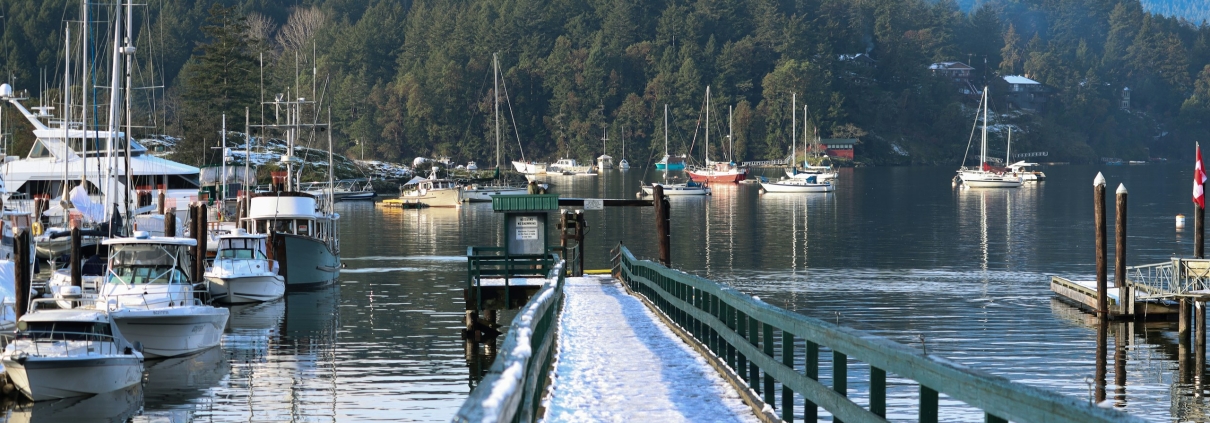
Deep Cove is where the District of North Vancouver runs out of road. The houses climb a steep, treed hillside above a small village, and the village sits on the water at the mouth of Indian Arm, with the mountains coming straight down to the shoreline opposite.
People who live here tend to say the same thing: it feels like a holiday town that happens to be twenty-odd minutes from a bridge into Vancouver. That is the appeal, and it is also the catch.
This guide is for someone deciding whether to buy here, or working out what their place here is worth. It covers what the houses are like, what goes wrong with them on this kind of land, the tax rules that quietly decide what you can afford, and what daily life actually involves. No price predictions, and nothing I could not check against a government or District source.
The short version
- Deep Cove is in the District of North Vancouver, not the City. Your zoning, permits, parking rules and development applications all go through dnv.org. Anything municipal can change, so call the District on 604-990-2311 or email infoweb@dnv.org before you rely on it.
- It is mostly detached houses on sloping, treed lots. Townhouses and apartments exist but are a small part of the stock, so there are far fewer entry-level options than in Lonsdale.
- The land itself is part of the due diligence. The District has slope hazard and wildfire hazard development permit areas. Check whether a lot is in one before you plan a renovation or rebuild.
- Waterfront is special, and so is the paperwork. The Province owns nearly all foreshore in BC, and a private dock needs provincial authorization. It does not come automatically with the house.
- The village is a destination. Summer weekends bring heavy visitor traffic, and the District runs seasonal pay parking at Deep Cove Park and Panorama Park.
- The commute is by road, over one bridge. TransLink’s 212 links Deep Cove with Phibbs Exchange, and some 211 trips run from Deep Cove straight through to Burrard Station downtown; there is no SkyTrain, SeaBus or RapidBus in the Cove.
- Two governments define “first-time buyer” two different ways, and on a new home the gap can be worth up to $50,000.
Where Deep Cove is, and which city hall you deal with
Deep Cove sits at the far eastern end of the North Shore, where Burrard Inlet turns north into Indian Arm. The village is a few blocks of shops and restaurants along the water, with Panorama Park on the waterfront.
It is entirely in the District of North Vancouver. That matters more than people expect, because the City of North Vancouver and the District are two separate municipalities with two separate sets of bylaws.
For anything in Deep Cove, the District’s site is dnv.org, its main line is 604-990-2311, its general email is infoweb@dnv.org, and municipal hall is at 355 West Queens Road. Municipal rules, fees and parking arrangements change. Confirm the current position with the District before you rely on anything in this article.
Like “Central Lonsdale”, the name “Deep Cove” does work in marketing that it does not do in law. Listings some distance from the village sometimes borrow it. Look at the actual address, and the actual walk to the water, before you pay for the name.
What kind of money this area is
I do not put price figures on a neighbourhood page. They go stale within weeks, and the number that matters is the one for your lot, your slope and your view.
In plain terms: Deep Cove is detached-house money. Because the stock is mostly houses, the cheapest way into the area is usually a townhouse or an older house that needs work, and there are not many of either.
Within the area the spread is very wide. A cabin-era house on a steep lot up the hill and a waterfront home with its own dock are different markets that happen to share a village.
For current numbers across the North Shore, see the North Shore market stats page, which I update against Greater Vancouver REALTORS’ monthly release.
What actually decides the price here
The view, and whether it faces the water. A house that looks across Indian Arm or down the inlet is a different asset from one that looks into the trees. On a hillside, the lot below you decides whether the view lasts. Here is how to find out what can be built in front of you.
The slope, and how you get to the front door. Steep driveways, long stairs and retaining walls are common here. They affect who the house suits, what it costs to maintain, and what can be built on the lot.
Walking distance to the village. Being able to walk down for coffee and a paddle is most of the reason people pay to live here. The further up the hill, the more the house behaves like a quiet suburban property.
Waterfront, and whether the dock is authorized. Direct water access is rare and priced accordingly. A dock with the right provincial paperwork is worth more than one without it.
Suite potential. A legal secondary suite changes the numbers for many buyers. What is allowed on a District lot has changed in recent years; here is how many homes can be built on one North Vancouver lot, and the District’s planning department can confirm it for a specific address.
The housing stock, by era
Cabin-era and early houses. Deep Cove started as a summer and weekend place, and some older, smaller houses still show it. Many have been added to over the decades, not always with permits. Expect original wiring and plumbing unless they have been replaced, and ask about a buried oil tank.
Post-war and 1960s-1970s houses. Much of the hillside was built out in these decades. Post-and-beam and West Coast designs with big windows and flat or low-slope roofs are common. They have real character and real maintenance: roofs, drainage, single-pane glazing and older electrical.
1980s and 1990s houses and townhouses. Larger houses and a limited number of townhouse complexes. For any strata of this era, read the minutes and the depreciation report closely.
Newer rebuilds. Where an older house has been replaced, you get modern insulation, drainage and wiring, but on a hillside lot the rebuild will have gone through the District’s permit process. Ask to see the permits and the final inspections.
What goes wrong with a house on this land
Water. Rain runs downhill, and on a steep lot it runs toward your foundation. Perimeter drains, sumps and the way the lot above you drains all matter. Ask the seller what has been done, and have the inspector look closely at the lowest level.
Retaining walls. Many lots rely on them. A failing wall is expensive, may need an engineer, and can involve your neighbour. Ask who built it, when, and whether it was permitted.
Unpermitted additions. Older houses here have often grown in stages. An addition built without a permit can cause trouble with insurance, financing and resale. Here is how to check a North Vancouver building permit history before you remove subjects.
Buried oil tanks. Homes of this age on the North Shore were often heated with oil. A standard home inspection does not scan for a tank. Here is what to do about it before you write an offer.
Older wiring and plumbing. Knob-and-tube wiring, aluminum branch wiring and polybutylene supply pipe all turn up in houses of these eras. Each is manageable, but insurers treat them differently. Talk to your insurer before you remove subjects, not after. The full checklist is in what to check on an older North Shore home.
The land rules: slope and wildfire
This is the section most buyers skip, and in Deep Cove it can matter more than the kitchen.
Slope hazard. The District has a Slope Hazard Development Permit Area, aimed at reducing the risk to people and property from landslides and rock fall. If a lot is in it and you plan to build or alter the land, you will generally need a development permit and an assessment report from a qualified professional engineer or geoscientist.
Wildfire hazard. The District also has a Wildfire Hazard Development Permit Area. A new building with living space in that area brings extra requirements, including a report from a registered forest professional and fire-resistant design.
Neither of these stops you from buying. They change what a renovation or rebuild costs and how long it takes. Before you write an offer on a house you intend to change, look the lot up on the District’s GEOweb property viewer and ask the District which permit areas apply. Rules can change, so confirm by phone or email.
Waterfront and docks
If a listing has its own dock, read this before you fall for it.
The Province owns nearly all freshwater and saltwater foreshore in BC. Owning the house above the water does not mean owning the water’s edge, and in common law the public keeps the right to access the foreshore.
Building, placing and using a private dock on Crown land requires authorization from the BC government. Many docks qualify under a General Permission if they meet set conditions; others need a Specific Permission or a lease.
So ask the seller for the dock’s authorization, and have your lawyer confirm it. A dock that cannot be authorized is a liability, not a feature. Start at the Province’s private moorage page.
The tax rules that change what you can afford
Everything in this section was checked against the government page on 21 September 2026. Several of these rules change on 1 January 2027. Check the source before you rely on a number.
The BC first time home buyers’ exemption
Full exemption from property transfer tax on the first $500,000 of the price if the fair market value is $835,000 or less. Between $835,000 and $860,000 the exemption shrinks, and above that it is gone.
In Deep Cove that means it rarely applies to a house. It can matter on a townhouse or apartment.
The test is strict. In the Province’s own words, you must have “never owned a registered interest in a property that was your principal residence anywhere in the world at any time.” Source: Province of BC, first time home buyers’ program.
The newly built home exemption
Full exemption at a fair market value of $1,100,000 or less, phasing out completely at $1,150,000. It has no prior-ownership test, so a repeat buyer can use it, but you still have to be a Canadian citizen or permanent resident and the home has to be your principal residence. Source: Province of BC, newly built home exemption.
GST on a new home, and the first-time buyers’ rebate
A newly built home attracts GST; a resale home normally does not. If you buy a new or substantially renovated home as a first-time buyer, the federal first-time home buyers’ GST/HST rebate can return up to $50,000.
The full rebate applies to homes at or below $1,000,000. It phases down between $1,000,000 and $1,500,000, and at $1,500,000 or more there is none. The agreement to purchase must have been entered into on or after 20 March 2025.
Source: Canada Revenue Agency, first-time home buyers’ GST/HST rebate.
The trap: two governments, two definitions
BC’s first-time buyer test is lifetime and worldwide. The federal test is a rolling window: you must not have lived in a home that you or your spouse or common-law partner owned in the current calendar year or the previous four.
So someone who owned a home eight years ago fails the BC test and can pass the federal one. And someone who has never owned anything can fail the federal test because their partner owned a home recently.
Check both separately, and get your accountant or lawyer to confirm before you sign.
If you are not a Canadian citizen or permanent resident
The federal prohibition on the purchase of residential property by non-Canadians is still in force. As the law stands today, it ends on 1 January 2027. It has already been extended once, so confirm the position again close to the time.
Separately, BC charges an additional property transfer tax of 20% on a foreign entity’s share of residential property in the Metro Vancouver Regional District, which includes the District of North Vancouver.
Always get a lawyer or notary to confirm eligibility. Sources: CMHC, prohibition on purchase by non-Canadians and Province of BC, additional property transfer tax.
Speculation and vacancy tax: the rates went up
The tax applies in the District of North Vancouver. For 2026 the rate is 1% for Canadian citizens and permanent residents who are not untaxed worldwide earners, and 3% for foreign owners and untaxed worldwide earners. From 2027 the higher rate rises to 4%.
From 2019 to 2025 those rates were 0.5% and 2%, so older advice is out of date. Every owner has to declare every year, even when nothing is owed. This matters in Deep Cove, where some buyers want a second home or a weekend place. Source: Province of BC, speculation and vacancy tax rates.
If you are thinking of renting it out short-term
Deep Cove gets plenty of visitors, so the idea comes up. BC’s principal residence requirement for short-term rentals applies in the District of North Vancouver.
That limits short-term rentals to the host’s own principal residence, plus one secondary suite or accessory dwelling unit on the same property. The District’s own bylaws and any strata bylaws apply on top. Start at the Province’s principal residence requirement page.
Schools
The schools closest to the village include Cove Cliff Elementary and Seycove Secondary, which is at 1204 Caledonia Avenue. Both are run by the North Vancouver School District.
Being close to a school is not the same as being in its catchment. Catchments are set by the district and can change, and French immersion and other programs have their own rules.
Run the exact address through the district’s School Locator, and if the school is a deciding factor, call the district and confirm in writing before you buy.
Getting around
Deep Cove is a drive-first neighbourhood. There are two ways out by road, along Dollarton Highway or up to Mount Seymour Parkway, and for downtown Vancouver both lead to the Ironworkers Memorial Second Narrows Crossing.
On transit, TransLink’s route 212 connects Deep Cove with Phibbs Exchange, a major North Shore bus exchange, where you transfer for Lonsdale and the rest of the North Shore. The 211 also starts in Deep Cove, at Panorama and Naughton, and runs along Mount Seymour Parkway to Phibbs Exchange, with some trips continuing over the Ironworkers Memorial Bridge to Burrard Station downtown, no transfer needed. There is no SkyTrain, SeaBus or RapidBus in Deep Cove itself.
Route names and timetables change. If you commute, do the real trip at your real departure time before you buy, and check translink.ca for what is running today.
The outdoors, and the summer crowds
This is why people move here. The water is on your doorstep for kayaking, paddleboarding and sailing, and the Baden-Powell Trail starts at the edge of the village. Quarry Rock, a short hike from the Cove with a view back over the water, is one of the busiest trails on the North Shore. That section of trail has been closed for repairs in the past, so check with the District for closures before you go.
Mount Seymour Provincial Park is up the road. In recent winters BC Parks has required a free day-use vehicle pass for some parking lots on peak days, so check BC Parks’ day-use pass page before you go.
The other side of that coin is visitors. On a sunny summer weekend the village is full and the roads in are slow. The District runs seasonal pay parking at Deep Cove Park and Panorama Park, and has studied wider parking changes in the village.
If you are looking at a house on one of the streets near the village or a trailhead, visit on a hot Saturday before you buy. Parking rules change, so check the District’s summer parking in Deep Cove page or call 604-990-2311.
What is being built nearby
Deep Cove has changed slowly compared with Lonsdale or Lynn Valley, but it is not frozen. Provincial housing legislation has changed what can be built on single-family lots across the District, and larger proposals still come forward on the edges of the area.
The District lists significant multi-family and commercial proposals on its development applications being considered page. Before you write an offer, look up the streets around the house you are buying.
If you want to know what a proposal means for your light, your view or your street parking, call or email the District, and do it before you remove subjects.
Who Deep Cove suits
It suits people who want the water and the trails as part of daily life, families who want a house and a yard, and people who work from home or can travel outside rush hour.
It does not suit anyone who needs to be downtown every morning at 8:30 without a car. It does not suit people who want flat, easy lots, or someone who wants to walk to a big grocery store, a hospital and a recreation centre.
It is also a poor fit for anyone buying mainly for short-term rental income, given the rules above. And if you plan a big renovation, budget time for the slope and wildfire permit process before you budget for finishes.
If you are looking at one specific address
Send it to me. I will pull the sale history, the title, the permit history, and what the District shows for that lot, including whether it sits in a slope or wildfire permit area, and tell you what I would want answered before I wrote an offer.
No charge, no obligation, and I will tell you if I think you should walk away.
Thinking about buying or selling in Deep Cove?
Leave your name and number and I will come back to you, usually the same day. Tell me the address if you have one and I will pull the sale history and the documents that matter before we talk. No charge, no obligation.
Prefer to talk now? Call or text 778-903-7306.
به فارسی: راهنمای دیپ کوو، نورث ونکوور
Strata buildings near Deep Cove
Each page shows the homes for sale there right now.
Read next
- Deep Cove vs Lynn Valley: which one fits you?
- Lynn Valley: the other big District neighbourhood for families
- What to check on an older North Shore home
- Buried oil tanks: the North Shore’s most expensive surprise
- How to check a building permit history in North Vancouver
- How many homes can be built on one North Vancouver lot
More guides for North Shore buyers and sellers are on the guides page.
Last checked 21 September 2026; last reviewed September 2026. This article is general information, not advice on any specific property, and it is not legal, tax or financial advice. Tax thresholds, municipal bylaws and permit areas, parking rules, transit routes, school catchments and development applications all change, and several of the rules described here change on 1 January 2027. Confirm the current position with the authority that owns it: the District of North Vancouver (604-990-2311, infoweb@dnv.org), the Province of BC, the Canada Revenue Agency, the North Vancouver School District, TransLink, BC Parks or your strata. Take advice from a lawyer, notary or accountant before you commit money.
Run your Deep Cove numbers before you make an offer
Three figures decide what you can actually buy here, and all three use 2026 BC rates.
- Mortgage and stress test — what a lender will actually approve
- Property transfer tax — 2026 rates and the exemptions
- Closing costs — what you need on top of the deposit

Tom Jahed, REALTOR®
Vanak Realty, North Vancouver. Ten years in North Vancouver real estate and more than 400 transactions closed, including pre-sales. Works in English and Farsi.
Written by Tom Jahed, licensed REALTOR®, Vanak Realty, North Vancouver.