
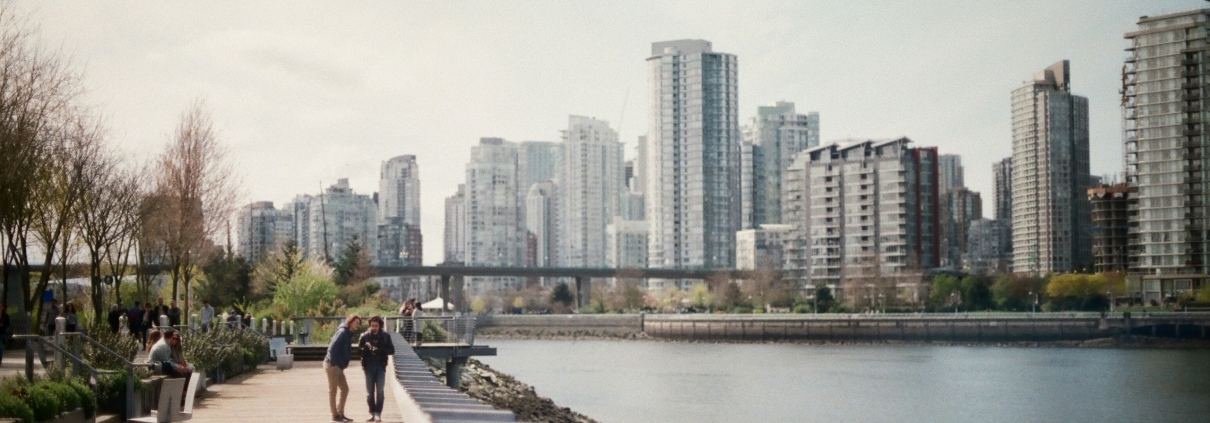
Most people meet Dundarave as the far end of a walk that started in Ambleside, and file it away as the quiet bit at the end of the seawalk. That is the wrong way round. Dundarave is a village in its own right. It has its own name, its own century-old commercial block, and its own building rules. Those rules are quite different from the ones the Province imposed on Ambleside in April 2026.
It is also small. The District’s own archives put the whole neighbourhood between 24th Street and 27th Street, and between the water and Palmerston Avenue. That is about three blocks wide. Almost everything that makes Dundarave worth buying into sits inside those three blocks, and so does almost everything that makes it frustrating.
This guide is about what is actually there, what the District says can be built there, and what you should check before you make an offer. There are no price figures on this page, because a neighbourhood average tells you nothing about a specific house. Current North Shore numbers are on the North Shore market stats page.
The short version
- Where: West Vancouver, roughly 24th to 27th Street, from Burrard Inlet up to Palmerston Avenue. Municipal Hall is at 750 17th Street, not in North Vancouver.
- The village: the District defines Dundarave Village as Marine Drive between 24th and 25th Street. Three of its buildings are on the community heritage register, the oldest from 1912.
- How tall anything can get: the commercial zone caps buildings at 10.7 metres. The one site-specific Dundarave zone caps them at 10.7 metres and three storeys. This is not Ambleside, where the Province adopted a plan allowing much taller buildings in April 2026.
- The beach: Dundarave Park has more than 50 metres of sandy beach, a lifeguarded swim area in summer, and it is where the 1.7-kilometre Centennial Seawalk begins. No bikes on the seawalk.
- Parking: Dundarave Park is not in the District’s pay parking programme. Ambleside Park is. Council has asked for a parking study that covers the Dundarave commercial area, preferably in time for 2027.
- Schools: Irwin Park Elementary is the school the district places in Dundarave. Check your own address with the school locator, because catchments change.
- Buses: three routes stop on Marine Drive inside the neighbourhood, and two of them carry the word Dundarave in their name.
- The catch: waterfront and near-waterfront lots sit in a Foreshore Development Permit Area adopted in 2022, and the Province’s small-scale housing rules are still unsettled in West Vancouver as of late September 2026.
On this page
- Where Dundarave is, and which city hall you deal with
- How Dundarave got its name, and how it used to be said
- The pockets: waterfront, village, and the slope above Marine
- What kind of money Dundarave is
- What actually decides the price here
- The housing stock, and what goes wrong in it
- The rules that decide what can be built
- What to check before you buy in Dundarave
- The village: what is on Marine Drive
- The park, the beach and the seawalk
- Parking, and why it is worth watching
- Schools
- Getting around
- What is being built and what is planned
- What locals like, and what they argue about
- Who Dundarave suits, and who should look elsewhere
Where Dundarave is, and which city hall you deal with
Dundarave is in the District of West Vancouver. That is a separate local government from the City of North Vancouver and from the District of North Vancouver, with its own bylaws, its own permit counter and its own school district. If you have been shopping on the other side of the Capilano River, assume nothing carries over.
The West Vancouver Archives record for Dundarave describes it as “roughly the area from 24th Street in the east to 27th Street in the west, and from Burrard Inlet in the south to Palmerston Avenue in the north”. People use the name more loosely than that in conversation, and listings stretch it further still, so check the address against that boundary rather than the wording of an advertisement.
Municipal Hall is at 750 17th Street, open 8:30 a.m. to 4:30 p.m. Monday to Friday. The main line is 604-925-7000 and the general address is info@westvancouver.ca. For anything about what you can build, Planning and Development Services is 604-925-7055, and Permits and Inspections is 604-925-7040. Every municipal rule on this page can change, so call or email before you rely on it.
How Dundarave got its name, and how it used to be said
The land was originally District Lot 555, the block between 24th and 26th Street from the waterfront up to Palmerston Avenue. According to the West Vancouver Archives, it was owned by Russel Elliot Macnaghten, who lived from 1860 to 1918 and taught classics at McGill University College in Vancouver and later at the University of British Columbia. He and others bought and subdivided the land in 1909.
Macnaghten named it after Dunderave Castle on Loch Fyne in Scotland, the ancestral home of his clan. The Archives add two details that almost nobody selling here knows. The name comes from Gaelic for “the two oars”, because the castle was reached by rowboat, and “Dun” means hill. And the final letter was originally pronounced as in the word “have”, not as in “rave”.
The name attached itself to the neighbourhood through the railway. When the Pacific Great Eastern Railway arrived in 1914 its stop at 25th Street was called Dundarave, and the Dundarave post office ran out of a grocery store on the south-east corner of 25th Street and Marine Drive. That corner is still the centre of the village more than a century later.
The District’s own walking tour of the neighbourhood, the Dundarave Time Walk, starts at a cairn in the middle of the boulevard at 24th and Marine. The site notes that it has been archived and is no longer maintained, so treat the businesses it names as historical, but the buildings and the dates are worth the walk.
The pockets: waterfront, village, and the slope above Marine
Three blocks does not sound like enough room for distinct pockets. It is, because the land tilts.
Bellevue Avenue and the waterfront strip
Bellevue runs along the water below Marine Drive. This is the smallest pocket and the most expensive, and it is the one with the most rules attached to it. Anything within 15 metres of the natural boundary of the ocean sits in the Foreshore Development Permit Area, which the District adopted on 11 April 2022 to deal with sea level rise, storm surge and wave effects. If you are buying here, that permit area is not a detail, it is the thing that governs what you can rebuild.
The village blocks on Marine Drive
The commercial core is Marine Drive between 24th and 25th Street, with shops spilling onto Haywood and Bellevue. Above and behind it there are apartments and duplexes within a short walk of the shops. If walkability is what you are buying, this is the pocket that delivers it, and it is also the pocket most exposed to whatever gets built next on Marine Drive.
Haywood, Kings, Lawson and the streets up to Palmerston
North of Marine the streets run east to west in terraces: Haywood, then Kings, then Lawson, climbing towards Palmerston Avenue. Houses here are mostly detached, the lots are ordinary suburban sizes rather than estate sizes, and the views improve with every block you climb. Irwin Park Elementary sits on Haywood, which is why this stretch fills with families at school times.
One practical difference between the terraces: the higher you go, the further you are from the beach, and in Dundarave the beach is much of the point. A block of elevation buys view and quiet and costs you the two-minute walk to the sand.
What kind of money Dundarave is
Dundarave is expensive, and it is expensive in West Vancouver terms rather than North Vancouver terms. It is not the cheapest way into West Vancouver, and it is not the most expensive either: the big estate lots are up the hill and out to the west, not here.
What Dundarave has instead is a spread. A one-bedroom apartment a block from the shops and a waterfront house on Bellevue are both Dundarave, and they are not in the same market as each other. That is why a neighbourhood average is close to useless here, and why I would rather show you numbers for the actual building or street you are looking at.
For the current benchmark prices across the North Shore, and what they have been doing, see the North Shore market stats page, which is updated as each monthly release comes out.
What actually decides the price here
- Which side of Marine Drive you are on. Below Marine means water, noise from the road in a different way, and the foreshore rules. Above Marine means view and a walk down.
- Whether the view survives a rebuild next door. View is the single most argued-about thing on the North Shore slope. See how view protection actually works.
- The walk to 25th and Marine. Inside the village, the difference between two blocks and five blocks is real money, especially for buyers who intend to stop driving.
- Lot shape and slope. A flat, regular lot on a terrace street is worth more to a builder than a steep or awkward one, and that feeds back into what your house is worth.
- What the building is, for apartments. Age, envelope history and the depreciation report move apartment prices here more than the postcode does. See what to look for in a depreciation report.
The housing stock, and what goes wrong in it
Dundarave’s housing was built in layers, and each layer has its own failure modes.
Pre-war houses. A handful of pre-1930 houses survive, including registered heritage ones like the 1923 house at 2512 Haywood Avenue. Expect original framing, old wiring, and at least the possibility of a buried oil tank. A buried oil tank is the single most expensive surprise in an old North Shore house, and it is worth resolving before you remove your subjects, not after.
Post-war and mid-century houses. The bulk of the detached stock. Roofs, drainage and perimeter drains are the usual costs, and many of these houses have been renovated once or twice with permits that may or may not have been closed. You can check a property’s permit history with the District before you commit.
Low-rise apartments. Buildings from the 1960s through to the 1990s sit behind and above the village. The building matters far more than the year: read the depreciation report, the minutes and the engineering reports, and pay attention to any envelope work already done or still planned. Rainscreen and envelope history is the thing that separates two otherwise identical units.
Newer infill. Duplexes and rebuilt houses appear throughout. West Vancouver designates certain areas as Duplex development permit areas under its Official Community Plan, which means form, character and streetscape are reviewed rather than left to the builder.
Two conditions worth checking anywhere on this slope, whatever the age: water coming at the house from uphill, and trees. Tree work can itself require a permit if it falls inside an environmental development permit area. The checklist for older North Shore homes covers the rest.
The rules that decide what can be built
This is where Dundarave differs most from the areas around it, and where the difference is easiest to check for yourself.
Height in the village is low, and it is written down
West Vancouver’s Zoning Bylaw No. 4662 sets a maximum building height of 10.7 metres in its Commercial Zone 2. Two storeys are permitted. A third is possible within that same height limit, if the ceiling of the lowest storey is no more than 0.3 metres above the curb.
The only zone in the whole bylaw named after the neighbourhood is CD38, listed as “IGA Dundarave Village”. It allows the uses of the Commercial Zone 2. It caps height at 10.7 metres and storeys at three. And it requires that residential floor area not occupy more than 70 per cent of a site’s total gross floor area. In other words, the site-specific zone written for Dundarave Village is a three-storey zone that has to stay part commercial.
Compare that with Ambleside, where on 7 April 2026 the Province issued an Order in Council adopting the Ambleside Centre Local Area Plan, in the District’s words, “for the Ambleside Commercial Areas”. Dundarave Village is not part of that commercial area and has no equivalent plan of its own. What it has is a Form and Character development permit area, the “Dundarave Village Neighbourhood Centre”, which reviews the look and shape of new buildings rather than raising how tall they can be.
Do not take a zone from this page and apply it to a specific lot. The District warns that its printed zoning maps “are only updated occassionally” and tells people to use WESTMap, its online mapping service, for the current position. It is free and you can look up any address yourself.
Five kinds of development permit, and three of them bite here
The District lists five main types of development permit area: Environmental, Wildfire Hazard, Foreshore, Form and Character, and Duplex. In Dundarave, the ones to check are:
- Foreshore. Adopted 11 April 2022, covering work within 15 metres of the natural boundary of the ocean, which is the high tide mark. It exists because of sea level rise, storm surge and flooding.
- Environmental. Required for work within 15 metres of the top of the bank of any watercourse, and the District states that this includes tree work. Creeks run down this slope, and one active application on Haywood Avenue is being processed as an environmental development permit for exactly this reason.
- Wildfire Hazard. Approved by Council on 14 December 2020, covering all properties within 100 metres of a forested area, which the District says is “approximately 50% of land in the District”. Dundarave is not the most forested corner of West Vancouver, but do not assume a given lot is outside it.
The small-scale housing rules are not settled yet
This is the most current thing on this page and the thing most likely to have moved by the time you read it. The Province’s small-scale multi-unit housing legislation required West Vancouver to update its bylaws by 30 June 2026. According to the District’s own page, Council gave first, second and third readings to Zoning Amendment Bylaw No. 5446, 2026 at its meeting on 21 September 2026, and the bylaw has been referred to the Ministry of Transportation and Transit, whose approval is needed before Council can consider fourth reading and adoption. The District states plainly that the bylaw “has therefore not yet been adopted”.
The minimum densities the legislation sets, as the District sets them out, are these:
- three units on a parcel under 280 square metres
- four units on a parcel of 280 square metres or more that is further than 400 metres from a prescribed bus stop
- six units, with no parking requirement, on a parcel of 281 square metres or more within 400 metres of one
Section 481.4 of the Local Government Act exempts land protected by heritage designation, land over 4,050 square metres, and land not served by municipal or regional water or sewer. The District says approximately 640 parcels are exempt across all zones.
Why this matters in Dundarave specifically: the village has frequent bus service on Marine Drive, and a good deal of the housing near it sits on ordinary-sized lots. If you are buying a house here on the assumption that you can build several units on it, get the current position from Planning and Development Services at 604-925-7055 in writing before you remove subjects. A bylaw at third reading is not a bylaw.
What to check before you buy in Dundarave
| What to check | Why it matters here | Where to check it |
|---|---|---|
| Whether the lot is in the Foreshore development permit area | Dundarave has a short, valuable waterfront strip; the area adopted on 11 April 2022 governs rebuilding within 15 metres of the high tide mark | District Planning and Development Services, 604-925-7055, and WESTMap |
| Whether a watercourse crosses or borders the lot | An environmental development permit is required within 15 metres of the top of bank, and the District says that includes tree work | WESTMap, then confirm with Planning |
| The actual zone on the parcel | The village runs on a commercial zone capped at 10.7 metres, plus one site-specific three-storey zone; the printed maps are, in the District’s words, “only updated occassionally” | WESTMap, then Permits and Inspections, 604-925-7040 |
| Whether the property is on the community heritage register | Five properties inside the neighbourhood are listed, including a 1923 house on Haywood Avenue; heritage-designated land is also exempt from the provincial small-scale housing rules | District community heritage register |
| The status of Zoning Amendment Bylaw No. 5446, 2026 | It had only first, second and third readings on 21 September 2026 and sits with the Ministry of Transportation and Transit; it decides how many units a lot may hold | The District’s small-scale multi-unit housing page |
| What is happening at 2468 Marine Drive | The village’s largest approved project changed hands out of receivership in August 2026 and the District says it has no information on the new owner’s plans | District development applications page for 2468 Marine Drive |
| Your school catchment, by address | Irwin Park is the school the district places in Dundarave, but catchments are set by address and change | West Vancouver Schools locator, or 604-981-1000 |
| Oil tank, drainage and permit history | Standard for pre-1960 North Shore houses, and much of the stock above Marine Drive qualifies | District Permits and Inspections, plus a tank scan before subject removal |
| Parking, if you are buying commercial or a walk-up | Dundarave Park is currently outside the pay parking programme, and Council has directed a study that covers the Dundarave commercial area | District destination parks pay parking page |
The village: what is on Marine Drive
The District defines the village precisely: “Dundarave Village – Marine Drive between 24th Street and 25th Street”. The business association for the area, the Ambleside and Dundarave Business Improvement Association, describes it as a strip where “Marine Drive is lined with coffee shops, stores, restaurants and services, and more can be found on Haywood and Bellevue Avenues”.
I have deliberately not listed individual shops and restaurants. Independent businesses on a two-block strip change, and a guide that names them is wrong within a year. What does not change is the built fabric, and that is unusually old for the North Shore.
Three buildings inside the village are on the District’s community heritage register:
- 2423 Marine Drive, Conservative Hall, 1913. The business association calls it one of West Vancouver’s oldest buildings. The District’s Time Walk records that it was built to house Conservative party members and has since served as a school, a badminton court, a dancehall, a church and a cabaret.
- 150 25th Street, The Clachan, 1912. Established by the Stephenson family as a hotel and tearoom, according to the Time Walk, and since occupied by a series of restaurants.
- 250 25th Street, the Dental Building, 1961, by the architects Wensley and Rand. The Time Walk notes that it is a modern office building designed with a residential feel so it fits the street.
Two more registered properties sit just off the strip: the 1959 Hanssen House at 1361 24th Street and the 1923 house at 2512 Haywood Avenue.
The village is also where the neighbourhood’s events happen. The business association runs the Dundarave Hoedown on Marine Drive between 24th and 25th Street; in 2026 it ran on Friday 28 August from 4 to 9 p.m. In December, Dundarave Park hosts the Dundarave Festival of Lights: Forest of Miracles, with over 100 decorated trees sponsored by local families and businesses and proceeds going to Hollyburn Community Services. At the time of writing the District had published the 2025 edition but not yet the 2026 dates.
The park, the beach and the seawalk
Dundarave Park is at the foot of 25th Street. The District calls it “one of the most visited parks in West Vancouver” and describes it as having “more than 50 metres of wide sandy beach and nearly a hectare of waterfront access”. For a neighbourhood park on a built-up shoreline, that is a lot of sand.
What is actually there: washrooms, picnic tables, a playground, a concession and the beach. The washrooms are open year-round from 6 a.m. to 10 p.m. The concession is open daily from 11 a.m. to 7 p.m. There is a designated swim area monitored by lifeguards in summer, and a floating swimming dock that goes in for the season and is removed at the end of September. As this was written the District’s page said lifeguards “have completed summer service and will be back in 2027”.
Two things people notice and then look up. Seven palm trees, donated to the District in the autumn of 2019, are planted near the beach where invasive plants used to be, with dune grass, driftwood logs and more benches planned. And there is a German Friendship Globe on the beach, which the District lists as public art.
The park is where the Centennial Seawalk begins. In the District’s words: “The popular 1.7-kilometre Centennial Seawalk extends from the bottom of 18th Street to Dundarave Park.” It was built in 1967 for Canada’s centennial. Bikes, boards and rollerblades are not permitted on it, which surprises people who assume a seawall means cycling. Dogs are allowed on leash, two per person, and off-leash only on the dog path behind the fence between 19th and 24th Street.
Some rules catch visitors out, and they are worth knowing if you are buying a house whose garden backs onto all this. Open fires, including beach fires, are prohibited year-round anywhere in West Vancouver. So are charcoal and briquette barbecues in parks and on beaches, and smoking and vaping in parks and on beaches. Drones are prohibited in West Vancouver parks except with express permission.
A piece of history for the park: the Time Walk records that the Fortune Cup Inn, a hotel and later an apartment building, stood on this site until 1971, when it was knocked down to increase the park space. The large Western Catalpa near the entrance, over nine metres tall, is older than most of the buildings around it.
Parking, and why it is worth watching
This is a small subject that is about to become a large one, and no other guide to the area mentions it.
West Vancouver runs a pay parking programme at its destination parks. According to the District’s page, pay parking is in effect at Lighthouse, Whyte Lake and Nelson Canyon, Whytecliff, Cypress Falls, Seaview Walk and Ambleside parks, year-round, 7 a.m. to 10 p.m., seven days a week. Dundarave Park is not on that list. Residents can apply for a free resident parking pass, and payment in the paid parks is by the PayByPhone and hangTag apps.
What is coming is on the same page. Alongside a direction to provide an initial 90-minute free parking session at Ambleside Park, Council passed motions to:
- update the existing 2019 Ambleside off-street parking study
- expand its scope to include the Dundarave commercial area
- consider integrating pay parking with District parks adjacent to the Ambleside and Dundarave commercial areas
The District says the study should be completed as soon as possible, “preferably for implementation in 2027”.
If you are buying an apartment without a parking stall, or a commercial unit on Marine Drive, or a house near the park that relies on street parking, that study is worth following. Free beach parking two blocks from your front door is part of what Dundarave sells, and the District has said in writing that it is being looked at.
Schools
Dundarave is in School District 45, West Vancouver, which is a different district from SD44 in North Vancouver. The district office is at 1075 21st Street, 604-981-1000.
Irwin Park Elementary, at 2455 Haywood Avenue, is the one school the district explicitly places in the neighbourhood: its own page opens “Irwin Park Elementary School is a K – 7 school situated in Dundarave”. The same page notes the school “is located within three blocks of commercial business properties”, which is a fair description of walking a child to school here. The District’s Time Walk records the school as designed by the West Vancouver architect Hugh Hodgson and built on land donated by a local resident.
Irwin Park does not offer French Immersion. The district runs Early French Immersion at École Cedardale and École Pauline Johnson, and Pauline Johnson also runs a single-track Late French Immersion programme for students entering Grade 6.
For secondary, West Vancouver Secondary School at 1750 Mathers Avenue describes itself as an International Baccalaureate World School. It does not advertise Advanced Placement, so do not assume both are available.
The caveat that matters more than any of the above: catchments are set by address, and they change. School District 45 tells families to use its school locator to find their catchment school, and you can look up any West Vancouver address in the school locator yourself. If a specific school is the reason you are buying a specific house, confirm it with the district at 604-981-1000 in writing, and do it before you remove subjects. Enrolment, programmes and boundaries are all the district’s to change.
Getting around
Three TransLink routes stop on Marine Drive inside Dundarave, and two of them are named after it.
- Route 250 runs between downtown Vancouver and Horseshoe Bay, with Dundarave in its route name. Its published stop list includes Marine Drive at 24th, 25th, 26th and 27th Street, so it serves the entire neighbourhood frontage.
- Route 255 runs between Dundarave and Capilano University, and terminates here. Its stops in the neighbourhood are Marine Drive at 24th and 25th Street.
- Route 253 runs between Caulfeild, Park Royal and Vancouver and also stops along this stretch of Marine Drive.
I am not printing journey times. Two separate readings of the published timetable for the same route did not agree, and a wrong commute time is worse than none. Put your own address and your own departure time into TransLink’s trip planner, and do it at the hour you would actually travel, because the Lions Gate Bridge is the variable that decides the answer. West Vancouver Transit’s information line is 604-985-7777.
Two things about driving. Everything eastbound funnels to the Lions Gate Bridge, and there is no SeaBus terminal in West Vancouver, so a downtown commute by transit means a bus over that bridge. On the other hand, Horseshoe Bay and the ferries are a straight run west on Marine Drive or the highway.
For cycling, the District installed separated bike lanes on the 2600 to 3000 blocks of Marine Drive, about 1.6 kilometres of one-directional eastbound and westbound buffered curbside lanes. To fit them, on-street parking was prohibited on both sides of Marine Drive between 26th and 31st Street.
What is being built and what is planned
2468 Marine Drive, the Pierwell site
This is the big one, and its story is unusual enough to be worth following closely if you are buying nearby. The District’s application page for the site records that at its meeting on 25 July 2022 Council approved a development permit for a three-storey mixed-use building on Marine Drive.
It then records that on 3 March 2026 the Supreme Court of British Columbia appointed MNP Ltd. as receiver and manager of the companies developing it, and that on 25 August 2026 the Court approved the sale of the site to Basel Capital. The District’s own words on what happens next: “The District has not received any information regarding the prospective new owner’s plans for redevelopment of the site.”
Practically, that means a prominent village site with an approved permit and an owner whose intentions are not public. If you are buying within sight of it, read that page before you write an offer, and ask what the current condition of the site is.
2512 Haywood Avenue
An active application to relocate and add to an existing non-conforming single-family dwelling that is a registered heritage building. It is being processed as an environmental development permit with variances, because of the 15-metre watercourse rule. The District invited written comments up to 4:30 p.m. on 7 October 2026, with Erika Syvokas, Community Planner, at 604-921-2914 as the contact. If you are reading this after that date, the outcome will be on the District’s development applications pages.
Bike lanes, and the block that said no
The District’s project page records what happened at the regular Council meeting of 11 March 2024. Council considered a staff report proposing a westbound bike lane on Marine Drive between 25th and 26th Streets. After a presentation from staff and comments from the public, “Council voted against the recommendation”. The lanes stop at 26th. That single decision tells you more about how this neighbourhood argues about its main street than any amount of description.
What locals like, and what they argue about
What works. You can live here without driving for most daily errands: shops, coffee, the beach, the seawalk and an elementary school are all inside a few blocks. The beach is a real beach with lifeguards in summer, not a viewpoint. The village has been a village for more than a century and the buildings show it. And the whole thing is small enough that people recognise each other.
What people argue about. Marine Drive. It is the high street, the bus route, the cycling corridor and the only through road, and every change to it is contested. The bike lane vote in March 2024 is the clearest example; parking is the next one, with a District parking study now directed to cover the Dundarave commercial area.
What frustrates buyers. Two things, usually. First, the village is genuinely small, so anyone expecting a full town centre will be disappointed and should look at Ambleside or Park Royal for that. Second, a prominent approved development site changing hands through a receivership leaves an obvious gap in the streetscape with no published timeline attached to it.
What surprises people after they move in. No bikes on the seawalk. No beach fires, anywhere in West Vancouver, at any time of year. Summer weekend traffic and parking pressure at the foot of 25th Street. And that the ocean is close enough to matter to your insurance and your permits, not just your view.
Who Dundarave suits, and who should look elsewhere
It suits people who want to walk: to coffee, to the beach, to school, to the bus. It suits downsizers who want a smaller home without giving up the water. It suits families who want an elementary school within a few blocks and are comfortable checking the catchment themselves. And it suits buyers who value an old, low-rise, legally low-rise village over a new one.
It does not suit a buyer who needs a big flat lot and a large new house; those are easier to find elsewhere in West Vancouver. It does not suit someone who wants a large shopping centre, cinemas and a full range of services on foot. It does not suit anyone who needs a fast, predictable transit commute to downtown, because everything crosses the Lions Gate Bridge. And it does not suit an investor counting on building several units on a single lot, at least not until the small-scale housing bylaw is actually adopted.
Dundarave on the map
Reading this in Farsi is easier for some of my clients: راهنمای خرید خانه در داندریو، وست ونکوور.
Thinking about buying or selling in Dundarave?
Leave your name and number and I will come back to you, usually the same day. Tell me the address if you have one and I will pull the sale history and the documents that matter before we talk. No charge, no obligation.
Prefer to talk now? Call or text 778-903-7306.
Strata buildings near Dundarave
The 12 closest of 29 buildings on my list. Each page shows the homes for sale there right now.
Read next
- Ambleside, West Vancouver: a buyer’s guide — the neighbour to the east, and a very different set of building rules
- North Shore market stats — the current benchmark prices, updated monthly
- Older North Shore homes: what to check — the list to work through on an older house
- Buried oil tanks on the North Shore — the most expensive surprise in an old house
- Rainscreen and envelope history in North Shore condos — what separates two identical-looking units
- How to check a property’s building permit history
- All of Tom’s North Shore neighbourhood and buyer guides
Disclaimer. This page is general information about a neighbourhood, not advice about a specific property, and nothing on it is legal, tax or financial advice. Municipal rules, zoning, development permit areas, school catchments, bus routes, park facilities and opening hours all change, sometimes with little notice. Every fact here was checked against the source linked beside it on 27 September 2026; last reviewed September 2026. Before you rely on anything on this page, confirm the current position with the authority that owns it: the District of West Vancouver at 604-925-7000 or info@westvancouver.ca for anything municipal, West Vancouver Schools at 604-981-1000 for catchments and programmes, TransLink for routes and times, and your strata for anything about a building. Take independent legal, tax and financial advice before committing money to a purchase or a sale.
Run your Dundarave numbers before you make an offer
Three figures decide what you can actually buy here, and all three use 2026 BC rates.
- Mortgage and stress test — what a lender will actually approve
- Property transfer tax — 2026 rates and the exemptions
- Closing costs — what you need on top of the deposit

Tom Jahed, REALTOR®
Vanak Realty, North Vancouver. Ten years in North Vancouver real estate and more than 400 transactions closed, including pre-sales. Works in English and Farsi.
Written by Tom Jahed, licensed REALTOR®, Vanak Realty, North Vancouver.