
Simple Steps for Vancouver Buyers in Today’s Market
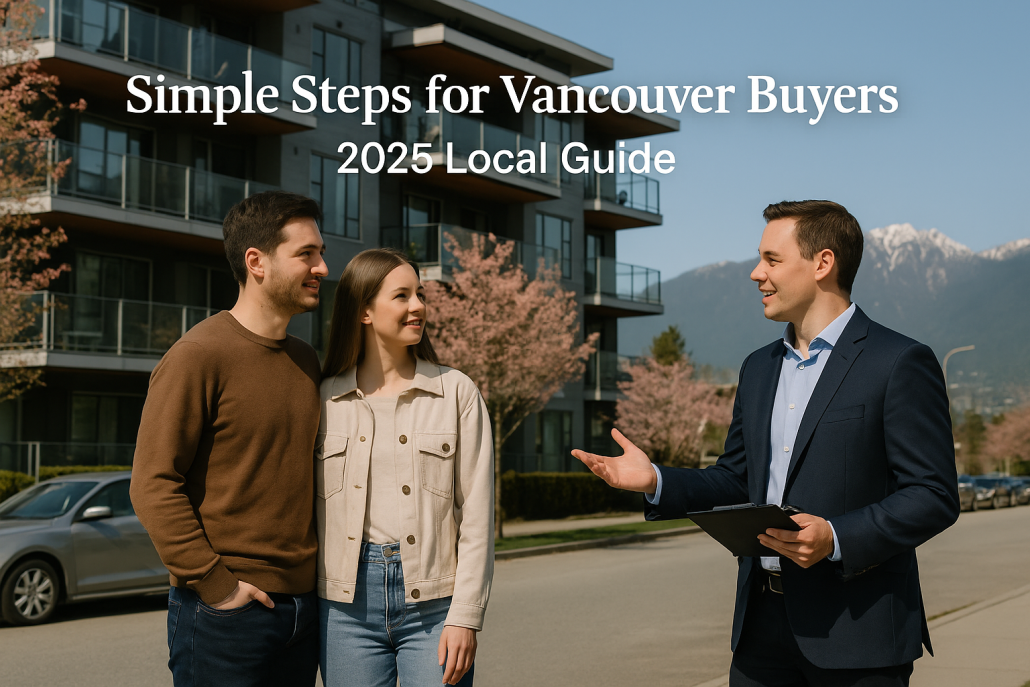
Simple steps for Vancouver buyers: 2025 local guide
In 2025, the average home price in Greater Vancouver is around $1.26 million, and the benchmark price for a typical home in Metro Vancouver sits just over $1.13 million.WOWA+1 Detached homes are closer to $1.9 million, which means every decision matters for buyers here.CREA Statistics At the same time, BC’s housing market is expected to stabilize with modest growth over the next couple of years, not the wild swings we saw before.British Columbia Real Estate Association+1 That’s exactly why simple steps for Vancouver buyers are crucial: you need a clear plan, not guesswork, to get into the market.
Across Canada, first-time buyers are renting for over six years on average before they purchase, and many are relying on gifts or inheritance to boost their down payment.Canada Mortgage and Housing Corporation+1 Add the federal mortgage stress test—where you must qualify at the higher of your contract rate plus 2% or 5.25%—and it’s easy to feel overwhelmed.OSFI+1 The good news? If you follow a few simple steps for Vancouver buyers, you can move from “this feels impossible” to “I have a concrete, realistic plan.”
Below is a straightforward, BC-focused roadmap you can follow, whether you’re a first-time home buyer or moving up in the Vancouver market.
Why simple steps for Vancouver buyers matter in 2025
The Vancouver market can look intimidating from the outside. Prices are high, inventory moves quickly, and mortgage rules keep changing. But the biggest risk isn’t the price; it’s going in without a structure.
Here’s why a clear, step-by-step approach matters right now:
- Prices are high but not out of reach. Vancouver benchmark prices are still below their 2022 peak, but they’re expected to edge up again as rates normalize and demand returns.WOWA+1
- Rates and rules are shifting. The Bank of Canada has been cutting rates from recent highs, and regulators continue to refine stress-test rules and mortgage insurance guidelines.Reuters+1
- Competition is intelligent, not just emotional. Serious buyers come in pre-approved, with deposit money ready, and a Realtor who knows neighbourhood-level data.
In this environment, simple steps for Vancouver buyers are less about “gaming the system” and more about putting structure around your decisions so you don’t overpay, over-stretch, or panic.
Step 1: Get brutally clear on your budget
Simple steps for Vancouver buyers to define the money side
Before you fall in love with a condo in Yaletown or a townhouse in North Vancouver, you need hard numbers. Start with three core questions:
- What’s my maximum purchase price based on income, debts, and down payment?
- What’s my comfortable monthly payment, including mortgage, strata fees, property tax, and insurance?
- How much cash do I have for closing costs and an emergency buffer?
Use a Canadian mortgage qualifier calculator, such as the Financial Consumer Agency of Canada’s Mortgage Qualifier Tool, to see what you might realistically qualify for under today’s stress test.itools-ioutils.fcac-acfc.gc.ca+1 This helps you translate your income into a price range that fits BC rules, not just your own optimism.
In BC, don’t forget:
- Property Transfer Tax (PTT): This can be a big hit unless you qualify for first-time buyer or newly built home exemptions.
- Strata fees: Especially important for condos and townhomes in Vancouver, North Vancouver, and Burnaby.
- Insurance and utilities: Older character homes on the East Side or older wood-frame buildings can have higher costs.
Write these numbers down. Once your budget is clear on paper, everything else becomes much simpler.
Step 2: Understand your buyer profile in the BC system
Not all buyers are treated the same in Canada. Where you land affects your options:
- First-time home buyer: You may qualify for federal programs like the First-Time Home Buyers’ Tax Credit, RRSP Home Buyers’ Plan, and BC’s property transfer tax exemptions on qualifying properties.Canada Mortgage and Housing Corporation+1
- Move-up buyer: You might carry equity from your current home but face higher PTT and potentially larger mortgages.
- Investor or secondary property buyer: Different down payment rules and stricter lender scrutiny often apply.
Take a moment and label yourself clearly: “I’m a first-time buyer,” “I’m a move-up buyer,” or “I’m an investor.” That one sentence tells your Realtor and mortgage broker which set of rules apply to you.
Step 3: Get pre-approved under the Canadian stress test
Simple steps for Vancouver buyers during mortgage pre-approval
The next move is to get a written mortgage pre-approval from a bank or mortgage broker that works regularly in BC. This is not just a quick online “pre-qualification.”
Ask your broker or lender:
- What’s my maximum purchase price under the current stress test?
- What interest rate are you using, and how long is it locked in?
- How would my approval change if rates fall or rise by 0.5%?
In Canada, the stress test means you must qualify at the higher of your contract rate plus 2% or a government-set floor rate (currently 5.25% for uninsured mortgages).OSFI+1 For Vancouver prices, that difference can mean tens of thousands of dollars in borrowing power.
A proper pre-approval gives Vancouver buyers three big advantages:
- You know your exact range, so you don’t waste time.
- Sellers and listing agents take your offers more seriously.
- You can move fast when a good home hits the market.
This step is non-negotiable. Any list of simple steps for Vancouver buyers that doesn’t include a real pre-approval is incomplete.
Step 4: Choose your core neighbourhoods
Trying to “buy in Vancouver” is too vague. You’re not buying the whole city; you’re buying one home on one street.
Narrow your search to 2–4 target areas based on:
- Commute and lifestyle: Downtown, Mount Pleasant, and Olympic Village vs. North Vancouver, Burnaby, or New Westminster.
- Housing type: Concrete condo, wood-frame, townhouse, or detached.
- School catchments and parks: Especially important if you’re planning a family in the next few years.
Use local tools like the Greater Vancouver REALTORS® MLS® Home Price Index comparison to see how different areas move relative to each other over time.Greater Vancouver REALTORS®+1 For example, you might find that one neighbourhood’s prices are softening slightly while another one is still very competitive.
Once you select your short list of areas, your Realtor can track new listings, price reductions, and days on market in those zones instead of the entire region. That’s how you stop scrolling endlessly and start focusing.
Step 5: Build the right local team
Even if you’re independent and love doing your own research, Vancouver is not the kind of market where you want to go completely solo. At minimum, your team should include:
- A BC-licensed Realtor who knows your target neighbourhoods and strata buildings.
- A mortgage professional (bank or broker) who works with BC and federal programs daily.
- A real estate lawyer or notary licensed in BC.
- Optionally, a home inspector with experience in West Coast construction, rain-screening, and local building issues.
According to recent Canadian mortgage surveys, almost a third of first-time buyers see their real estate agent as the most valuable person on their team, especially in complex markets.Canada Mortgage and Housing Corporation+1 The right team doesn’t remove your responsibility, but it gives you better information and better protection.
If you don’t already have a trusted Realtor, this is a good moment to [INTERNAL LINK HERE] and learn how to choose someone who fits your style and goals.
Step 6: Preview, compare, and refine your criteria
Don’t rush straight into offers. Start by previewing homes that fit your budget and target areas. After every showing, ask yourself:
- What did I like or dislike about the layout?
- How did the street, building, or strata feel?
- Was there anything that surprised me about the size, finishes, or noise?
Within a few weekends, you’ll see patterns: maybe you hate ground-floor units, or you love newer concrete buildings with amenities, or you prefer older units with more square footage.
This is one of the most powerful simple steps for Vancouver buyers: use early showings as data, not emotional triggers. Instead of “I must buy the next one,” think “This showing helps me dial in my ideal home profile.”
Step 7: Understand strata, inspections, and hidden risks
In Vancouver, a huge portion of the market is strata: condos and townhomes. To protect yourself, you and your Realtor should carefully review:
- Strata minutes and AGM documents
- Depreciation reports
- Special levies (past and upcoming)
- Insurance coverage and deductibles
Big red flags might include repeated water leaks, unresolved building envelope issues, or upcoming major work with no savings in the contingency reserve fund.
For detached homes, focus on:
- Roof age and condition
- Drainage and moisture (critical in our rainy climate)
- Electrical and plumbing updates
- Additions or renovations done without permits
This step isn’t glamorous, but it’s where future stress (or peace of mind) is created.
Step 8: Craft smart offers, not just high offers
When you’re ready to offer, price is only one piece of the strategy. Your Realtor will help you structure:
- Subject conditions: financing, inspection, review of strata docs, and sometimes sale of buyer’s property.
- Timelines: subject removal dates and completion/possession dates that work for both sides.
- Deposits: typically payable within 24 hours of accepted offer in BC and held in trust.
In a balanced or softer market, you can often keep reasonable subjects and still negotiate on price. In hotter pockets, you may need to shorten timelines or be more flexible on completion dates.
Simple steps for Vancouver buyers at this stage include:
- Decide your walk-away number before you offer.
- Know your maximum but aim to buy comfortably below it.
- Keep emotion in check with real comparables, not just list prices.
Step 9: Plan your closing and move like a pro
Once you have an accepted offer and subjects are removed, your focus shifts to closing and moving. In BC, that usually means:
- Your lawyer or notary receives instructions from the lender and prepares documents.
- You sign closing documents a few days before completion.
- Your down payment and closing costs are wired to the trust account.
- On completion day, funds are transferred and the title is registered in your name.
- On possession day (often the next day), you get keys and can move in.
Use this time to set up:
- Home insurance
- Utilities and internet
- Mail forwarding
- Move-in bookings for strata buildings (elevators, deposits, etc.)
Treat closing like a project with a checklist, not something to scramble through at the last minute.
Step 10: Think long-term, not just “getting in”
Buying your first or next home in Vancouver is a big milestone. But the real win comes from thinking beyond the keys. Ask yourself:
- How long do I realistically plan to stay in this home?
- If rates drop or my income increases, what’s my plan—refinance, renovate, or move up?
- Does this home support my lifestyle and mental health, not just my spreadsheet?
Canada-wide data shows that many buyers could still have purchased even without family gifts, but would have needed to compromise on location or property type.CMHC Assets+1 Those “compromises” can actually become smart stepping stones in Vancouver if you see your home as part of a 5–10 year plan, not your final forever place.
Final thoughts: Turn information into action
The Vancouver market can feel like a maze, but it doesn’t have to be. When you break things down into simple steps for Vancouver buyers—budget, profile, pre-approval, neighbourhoods, team, due diligence, smart offers, and a clear long-term plan—you remove a lot of fear and guesswork.
If you’re serious about buying in Vancouver or the North Shore, don’t try to figure everything out alone. Reach out to a local, data-driven Realtor, connect with a trusted BC mortgage professional, and start putting your plan on paper.
You don’t have to buy tomorrow. But you should know exactly what it would take to become a homeowner here. When you’re ready, book a call, ask your questions, and let’s walk through these simple steps for Vancouver buyers together—one clear step at a time.
External Link + Internal Link Placeholder
- External authoritative resource:
Mortgage Qualifier Tool — Financial Consumer Agency of Canada (Government of Canada)
https://itools-ioutils.fcac-acfc.gc.ca/MQ-HQ/MQ-EAPH-eng.aspx - Internal link placeholder:
Learn more in this detailed Vancouver first-time buyer guide: internal links: https://tomjahed.ca/realtor-north-vancouver-2025-market-datarealtor-north-vancouver-how-to-choose/

Leave a Reply
Want to join the discussion?Feel free to contribute!